16 Axioms
We began this part by throwing away Euclid’s postulates and starting over, with nothing but the plane \(\RR^2\), a tangent space at each point, and the Pythagorean theorem holding infinitesimally. Everything since has been built from that one axiom together with calculus.
It is worth stopping to check that we did not lose anything along the way. Euclid’s five postulates were never assumed here - so if the geometry we have built really is the geometry of Euclid, each of them ought to be a theorem.
Definition 16.1 (Euclid’s Postulates)
- A straight line segment can be drawn joining any two points.
- Any straight line segment can be extended indefinitely in a straight line.
- Given any straight line segment, a circle can be drawn having the segment as radius and one endpoint as center.
- All right angles are equal.
- If two lines are drawn which intersect a third in such a way that the sum of the inner angles on one side is less than two right angles, then the two lines inevitably must intersect each other on that side if extended far enough.
16.1 Proving Euclid’s Postulates
Each postulate first has to be restated in our own language, where a line is a distance minimizing curve and a rigid motion is an isometry. Once that is done, we have already proven nearly all of them.
Proposition 16.1 (Proving Postulate I) For any \(p,q\in\EE^2\) there exists a distance minimizing curve \(\gamma\colon[0,1]\to \EE^2\) with \(\gamma(0)=p\) and \(\gamma(1)=q\).
Proof. Write down the curve \[\gamma(t)=p+t(q-p)\] which has \(\gamma(0)=p\) and \(\gamma(1)=q\). Its coordinates are affine functions of \(t\), so by Corollary 11.2 it is a line: that is, a distance minimizing curve.
Proposition 16.2 (Proving Postulate II) Every distance minimizing segment is a piece of a line defined for all time.
Proof. By Theorem 11.5 a distance minimizer is straight, and by Corollary 11.2 the affine curve \(\gamma(t)=p+t(q-p)\) is a line for every value of \(t\), not just those in \([0,1]\). The segment from \(p\) to \(q\) is its restriction to \([0,1]\), so letting \(t\) range over all of \(\RR\) extends it indefinitely.
Proposition 16.3 (Proving Postulate III) For any \(p\in\EE^2\) and any real number \(r>0\) the set \(\{q\in\EE^2\mid \dist(p,q)=r\}\) of points at distance \(r\) from \(p\) is nonempty.
Proof. By Theorem 11.6 the distance from \(p=(p_1,p_2)\) to \(q=(q_1,q_2)\) is \(\sqrt{(q_1-p_1)^2+(q_2-p_2)^2}\). The point \(q=(p_1+r,p_2)\) therefore lies at distance \(r\) from \(p\), so the set is nonempty; Theorem 12.1 identifies the whole set as the circle of radius \(r\) about \(p\).
Note that it is important we are using the real numbers here! If we only had the rational numbers, the circle \(x^2+y^2=3\) would have no points on it at all.
Proposition 16.4 (Proving Postulate IV) If \(u,v\) are two orthogonal unit vectors based at \(p\), and \(u^\prime,v^\prime\) are two orthogonal unit vectors based at \(p^\prime\), then there is an isometry of \(\EE^2\) taking \(u,v\) to \(u^\prime,v^\prime\).
Proof. By Proposition 10.2 there is an isometry \(\phi\) carrying the pair \(p,u\) to the pair \(p^\prime,u^\prime\). Isometries preserve angle measure (Proposition 13.1), so \(\phi\) carries \(v\) - the unit vector orthogonal to \(u\) at \(p\) - to a unit vector orthogonal to \(u^\prime\) at \(p^\prime\). There are only two such vectors, \(v^\prime\) and \(-v^\prime\). In the first case we are done; in the second, compose \(\phi\) with the reflection fixing the line through \(p^\prime\) in the direction \(u^\prime\), which is an isometry by Proposition 11.2.
Proposition 16.5 (Proving Postulate V, via Playfair’s Axiom) Given any line \(L\) and any point \(p\) not on \(L\), there is exactly one line through \(p\) which does not meet \(L\).
Proof. This is Proposition 11.4, proven when we studied lines. As discussed in Remark 2.1, Playfair’s Axiom is equivalent to Euclid’s fifth postulate given the first four, which we have just established.
Corollary 16.1 (Euclid’s Plane Geometry, Recovered) Every result in Euclid’s plane geometry - the material of Books I through VI - is a theorem of our geometry. (His remaining books concern number theory and solid geometry, which live outside \(\EE^2\).)
16.2 Equivalent Axiom Systems
Euclid’s postulates were chosen with care to be both self-evident and useful. But they are by no means the only possible axiom set on which one could base Euclidean geometry. Just like it is possible for other statements to be equivalent to Postulate 5, it’s also possible for another set of axioms to be equivalent to Euclid’s:
Definition 16.2 (Equivalent Axiom Systems) Two axiom systems \(\mathscr{A}\) and \(\mathscr{B}\) are equivalent if you can both use the axioms of \(\mathscr{A}\) to prove the axioms of \(\mathscr{B}\), and vice versa.
In modern math, when defining something axiomatically we often prefer to choose axioms whose meaning is clear. Can we formulate a collection of axioms equivalent to Euclid’s, that capture the essence of the geometry of the plane?
16.3 A Modern Perspective
16.3.1 Space is Complete and Infinite
The first three axioms of Euclid focus on the ability to draw lines (between any points, and of any length) and circles (of any radius). All of these together work to capture the property that space doesn’t have any holes, and goes on forever.
Definition 16.3 (Complete Space) A space \(X\) is complete if it does not have any holes, gaps or boundaries. Intuitively, a space is complete if you can continue walking straight in any direction, for as long as you like.
It is easiest to explain this notion by giving non-examples. The unit disk \(D=\{(x,y)\in\RR^2\mid x^2+y^2\leq 1\}\) is not complete because if you start at the center you only have to walk one unit before you have to stop: you’ve reached the edge of space!
The punctured plane (all of \(\RR^2\), with the origin removed) is also not complete: any line segment passing through the origin in \(\RR^2\) cannot exist in this space; if you were to try and walk along it, you would have to stop when you hit the missing point!
But being complete does not imply that space is infinite: indeed, the surface of the earth is complete, but finite in size! Anyone who starts walking in any direction on the earth’s surface can continue walking forever without falling off the world; they’ll just come back to their old location over and over.
The other property that we moderns would see as implicitly underlying the first three axioms of Euclid is the infinitude of space.
Definition 16.4 (Infinite Space) A space \(X\) is infinite if there are pairs of points arbitrarily far apart from one another.
The way to check if a space is infinite is to ask, “for every natural number \(N\), can I find a pair of points farther apart than \(N\)?” From this reasoning, we can see that the real line \(\RR\) is infinite, as we can look at the points \(0\) and \(N+1\): they’re at distance \(N+1\) apart, which is greater than \(N\). The same argument applies to the plane or 3-dimensional space, or any \(\RR^m\).
But this fails for the sphere: while it is complete, it’s finite in size. The farthest two points can possibly be from one another is when they are antipodal (like the north and south poles). And these points are only distance \(\pi\) apart, so there are no points on the unit sphere at distance greater than \(\pi\).
16.3.2 Space is Homogeneous and Isotropic
Euclid’s fourth postulate is short and intuitive: all right angles are equal. But it’s actually doing a lot of work! To see this, we must unpack what Euclid meant. Two angles are equal (in their measure) if they are congruent: that is, if there is a rigid motion of space that carries one to the other. Thus, Euclid here is claiming that you can always translate and rotate space so that any right angle is carried to any other.
We moderns would naturally separate this into two actions: you can translate space to carry any point to any other, and then you can separately rotate space about any point, carrying any direction to any other. These are exactly the properties of homogeneity (Definition 10.4) and isotropy (Definition 10.5) that we met when studying isometries, and Proposition 10.2 is the statement that \(\EE^2\) has both.
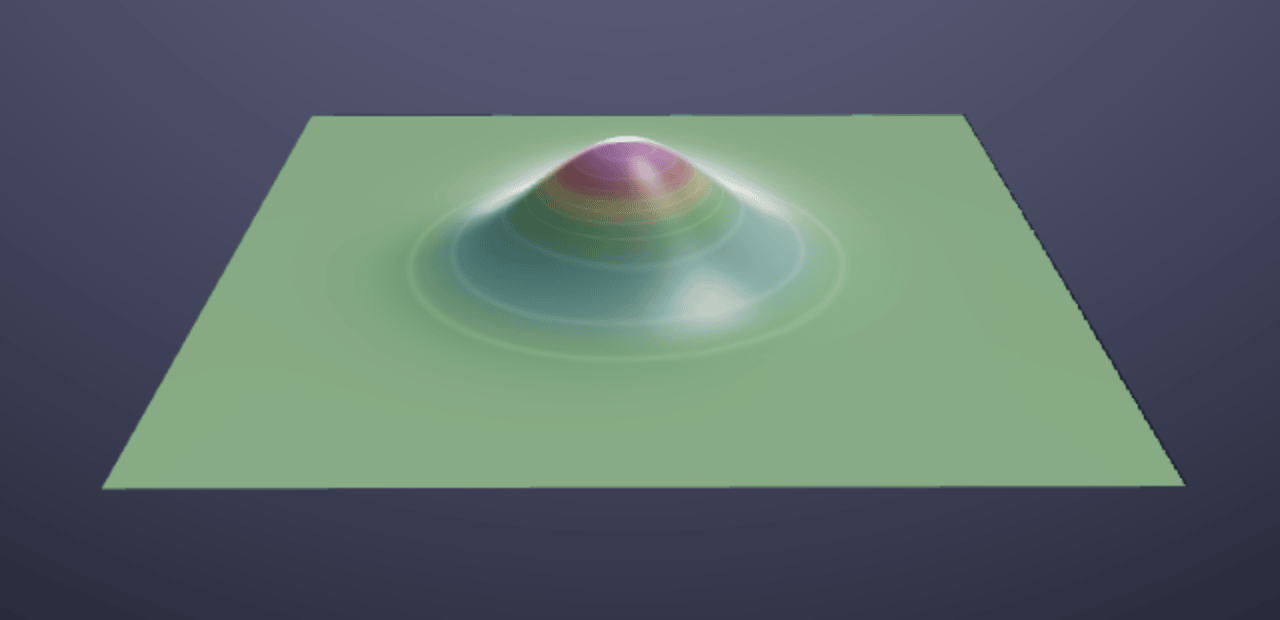
These two properties are not independent of one another.
Proposition 16.6 For a complete space, isotropy implies homogeneity.
Proof. Let \(p\) and \(q\) be distinct points of a complete space \(X\), and draw the line segment between them - completeness is what guarantees there is one. Say this line segment is of length \(L\), and mark the point \(m\) which is at distance \(L/2\) along it: the midpoint. Since \(X\) is isotropic, there are rotations about \(m\) of any angle we wish.
Rotate about \(m\) by 180 degrees: this exchanges the points \(p\) and \(q\). Thus there is a motion of \(X\) taking \(p\) to \(q\), so \(X\) is homogeneous as claimed.
In two dimensions, it turns out that homogeneity also locally implies isotropy: if a space looks the same at every point, then near each point it also looks the same in every direction. But this is false in higher dimensions! Indeed, some of my favorite spaces are three dimensional worlds which are homogeneous but not isotropic.
16.3.3 Space is Flat
The fifth axiom, and all of its equivalents, capture something about space above and beyond the fact that it is infinite in extent and looks the same at every point.
By the list of equivalents to postulate 5, this additional bit of information has a lot of effects on the space: it determines how lines, circles, and triangles behave and it forces the Pythagorean theorem to be true!
It is hard to give a good measure of the deviation from flatness until we have seen an example of a space which fails to be flat - the sphere, coming next. We could take any of the equivalents of the parallel postulate as our axiom, but the one that will generalize best is the statement about universal constants:
Definition 16.5 (Flat Space) A space is flat if the ratio of circumference to radius is the same constant for all sufficiently small circles, no matter where they are centered.
For now it may help to hold on to the following intuition: the plane is flat, and any surface you can make by bending the plane without stretching is also flat. Thus, the surface of a cylinder is flat, as you can roll up a sheet of paper without stretching it, as is the surface of a cone - everywhere except at its sharp tip, where small circles come up short.
Putting all of this together gives an axiom system equivalent to Euclid’s - we will not check the equivalence in detail here - in which every axiom is a statement about the space itself rather than about what can be drawn in it.
Definition 16.6 (Modern Axioms for Euclidean Geometry) The Euclidean plane is
- Complete
- Infinite
- Homogeneous
- Isotropic
- Flat
There are spaces which are not flat - the surface of a sphere, for one. Our definition of flatness (and the lack thereof - curvature) will require mathematics beyond the Greeks, and we will return to it in detail now that our geometric foundations are built from calculus.